Neo · · 29 min
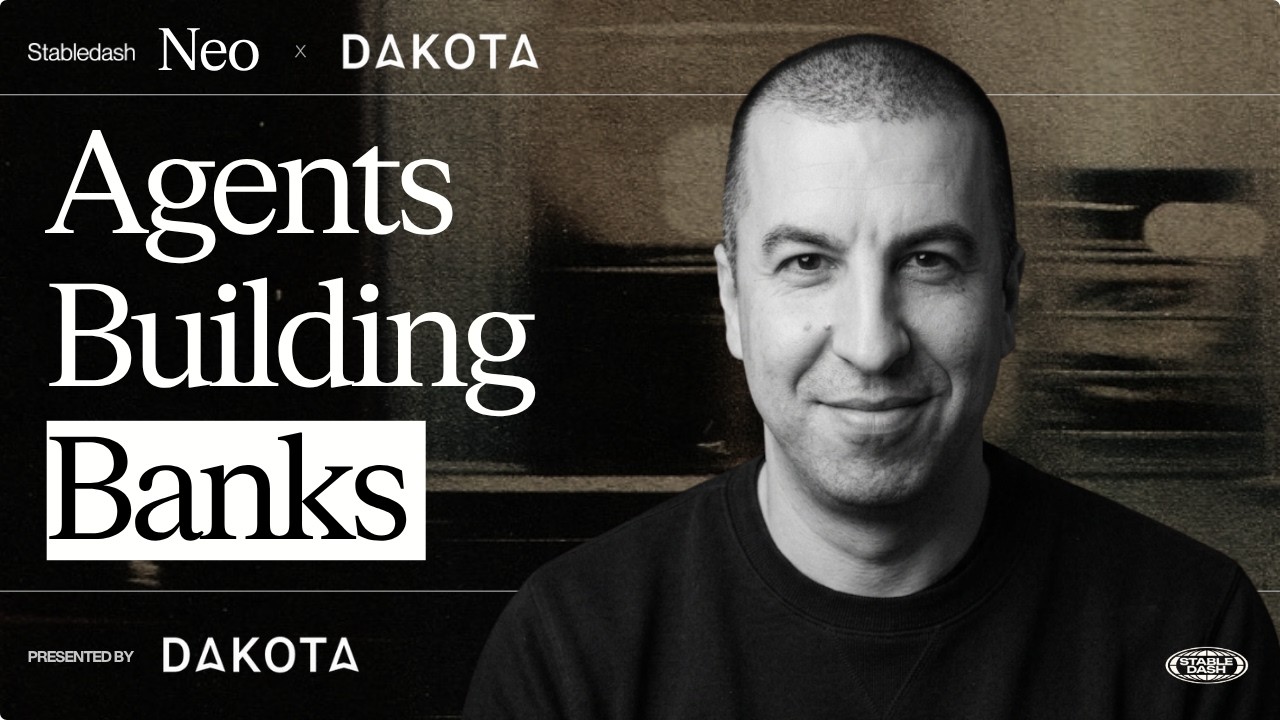
Dakota's Agent Layer Explained: an AI System Working Directly On Top of Regulated Money Rails
With  Ryan Bozarth
Key takeaways
Ryan Bozarth cites payment scan data showing dollar-backed stablecoins funded 70% of more than 10,000,000 tracked transactions in July, with USDC at 50.8% and USDT at another 20%.
Dakota has spent this year building primitives for agentic tasks with money, including mandates with explicit policies and spend limits.
Dakota's agent can be reached through an MCP server in Claude Code or a client in Slack, and Bozarth says the goal is to stay out of the relationship between clients and their customers.
Watch the episode
0:00Crypto card spending passes $1 billion in July1 of 8
Summary
As crypto card spending passes $1 billion a month, Dakota is building agent tools on regulated money rails that its clients can sell under their own brands.
Dollar-backed stablecoins funded 70% of the more than 10,000,000 tracked crypto card transactions in July 2026, according to payment scan data cited by Ryan Bozarth, co-founder and CEO of Dakota. USDC accounted for 50.8% of July volume and USDT another 20%, he said, in an interview that also included a demo of Dakota's agent tools for payments.
Card spending crosses a line
Bozarth pointed to a CoinDesk report that crypto card spending topped $1,000,000,000 in the month of July "as stablecoins move into everyday purchase." The stablecoin share of tracked transactions, he said, came mostly from two tokens: USDC with 50.8% of July volume and USDT with 20%.
“Our goal is to make it as easy as possible for our clients to build these products. And so when you're in Slack, our goal is not to inject the code into the relationship with you and your customer. It is to give you a set of primitives that make it very easy for you to build”
Ryan BozarthPrimitives for agents
Dakota says it has spent a lot of time this year building what it describes as the primitives for performing agentic tasks with money. Many of its design partners have been building products on these APIs, and the tools include mandates that can carry explicit policies or spend limits.
In the demo, the Dakota agent was added as an MCP server inside Claude Code, where a user could ask simple questions such as "show me my balance."
Paying invoices from chat
A second route runs through Slack. Using what Dakota calls a Slack client, a user can write "hey, Dakota, can you pay this invoice for me?" and have the agent handle the request inside the chat tool.
Staying invisible
Bozarth says Dakota does not want its brand in front of end users. "Our goal is to make it as easy as possible for our clients to build these products," he said, adding that in Slack the aim is not to inject Dakota into the relationship between a client and its customer, but to give clients primitives that make building easy.
Taken together, Bozarth's figures show stablecoins already funding most tracked card transactions. Dakota's bet is that the next layer will be agents acting on those balances within set limits, built by its clients and sold under their names rather than Dakota's.




Slack, Dakota, Citi, and CoinDesk come up most.
- People
- Ryan Bozarth
- Companies
- Slack
- Dakota
- Citi
- CoinDesk
- Stripe
- Anthropic
- Coldwell Banker
- Dfns
- JPMorgan Chase
- Slack Technologies


