Stabledash Live · · 27 min
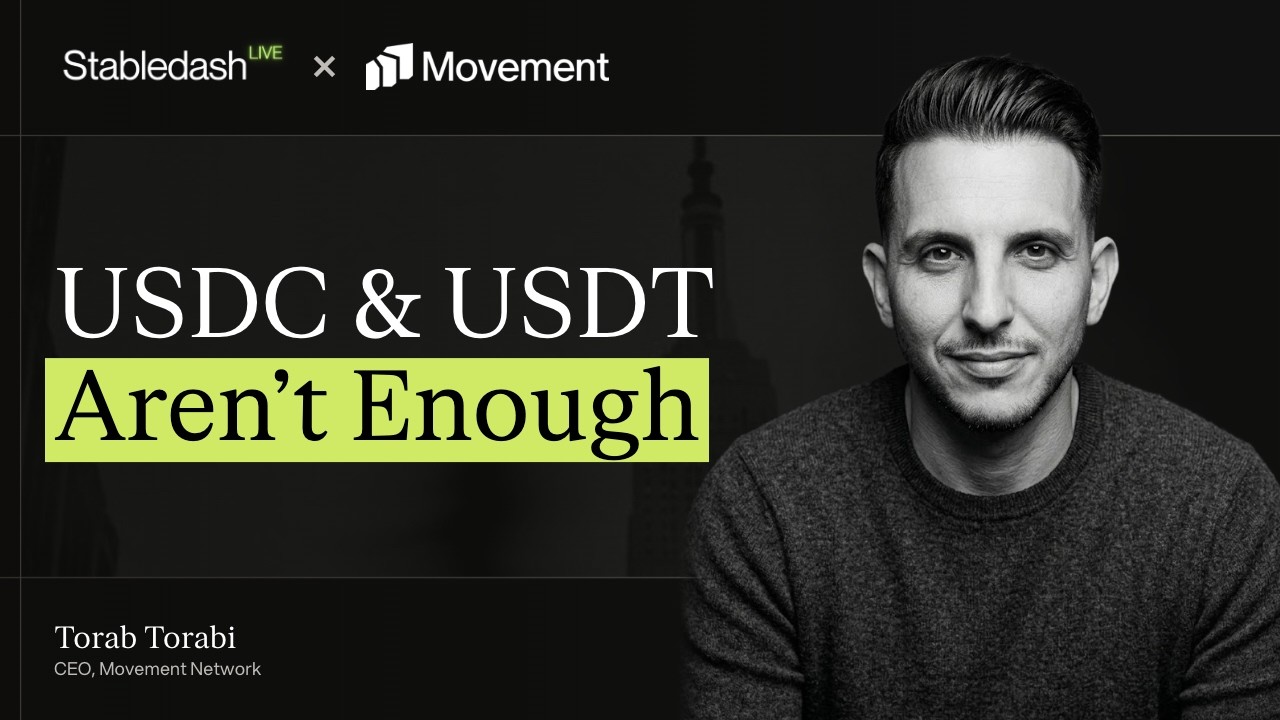
The Flaw in the USD Stablecoin Thesis: Movement CEO Torab Torabi
With  Torab Torabi
Key takeaways
Drew Rogers says Ethiopia has a 13% spread between the bank rate and the gray market rate, and that the country loses $450 million a year in remittance fees.
Movement is shifting its chain to focus on payments, remittances, stablecoin settlement and yield, and has announced licensed payment rails in the US, EU and Canada with KAST and Avant Protocol.
Rogers predicts every nation will tokenize its local currency and bonds, with one winning issuer per country, and expects central banks will want to issue the tokens themselves.
Watch the episode
Summary
Movement is changing course to become a payments and stablecoin settlement chain for emerging markets, and Rogers argues that every country will have to tokenize its own currency to compete with the dollar.
Drew Rogers of Movement says sending money into Ethiopia through a bank costs 13%, the spread between the official rate and the street rate. He uses that gap to explain why Movement is changing course to become a chain focused on payments, remittances, stablecoin settlement and yield.
Ethiopia's remittance gap
Drew Rogers says Ethiopia receives $7 billion in official remittances every year, and another $9 billion arrives through the gray market or hawala. The country loses $450 million a year in remittance fees, which he puts at roughly half the value of its coffee exports to Europe. "You lose 13% by going through a bank," he says.
“I don't wanna change consumer behavior. You know, if you like Coca Cola, I'm not gonna convince you to drink Shasta”
 Drew Rogers
A payments chain
Movement launched USDCx in March 2026. It is a USDC-backed stablecoin native to its M1 mainnet that can be minted without third-party bridges and works across 30-plus chains through Circle's xReserve. The company has now announced licensed payment rails across the US, EU and Canada. It is partnering with Avant Protocol and with KAST, a stablecoin neobank with more than one million users and roughly $5 billion in annualized volume.
Host Zach Fowler pointed to 300,000 KYC-verified users across the ecosystem. Rogers says the goal is to hide the technology: "If you know it's crypto, you're not doing a good enough job." He says he does not want to change how consumers behave.
Every currency on chain
Drew Rogers says the US dollar stablecoin market has two winners, USDC and USDT. He believes every country has to tokenize its local currency, and its government bonds too, to compete. He points to Turkey paying 40% on lira bonds to compete with the dollar and the euro. In his view each country will end up with one stablecoin issuer in a winner-take-all market, and his hunch is that central banks will want to issue these tokens themselves.
After the freeze
Drew Rogers says he has been in the ecosystem for almost three years and was the second hire. He recounts that Binance found market maker irregularities, froze $38,000,000 and returned the money to the foundation to buy back tokens. A cofounder of Movement Labs was suspended and removed five days later. Rogers says the current organization, which now goes by Movement, is completely separate and acts as steward of the ecosystem. He reports a retention rate of over 90% since then.
Rogers presents Movement as stablecoin infrastructure for markets where moving money is expensive, and he wants users never to notice the blockchain underneath. He sums up the approach this way: "we wanna do well so we can do good."




Movement, Monad, Circle, and Movement Labs come up most.
- People
- Drew Rogers
- Christopher Grilhault des Fontaines
- Torab Torabi
- Zach Fowler
- Companies
- Movement
- Monad
- Circle
- Movement Labs
- Binance
- Avant Protocol
- KAST
- Dfns
- Hyperliquid
- Marinade
- Salesforce
- Sensor Tower