Stabledash Live · · 18 min
Stablecoin Liquidity Networks, Programmable Money, and Moving $10M in Under 10 Seconds
With  Ryne Saxe, Eco
Key takeaways
Eco tested its crowd liquidity program by putting money from a $100 hat into its first pool, and Saxe says the fees paid out are usually around $5 to $10 a week.
Ryne Saxe says Eco can move $10,000,000 with 99.9% reliability in less than ten seconds, and that he knows of no one else who can do that today.
Saxe says much of the institutional adoption is stuck in pilot phase until GENIUS rulemaking or the Clarity Act brings more certainty.
Watch the episode
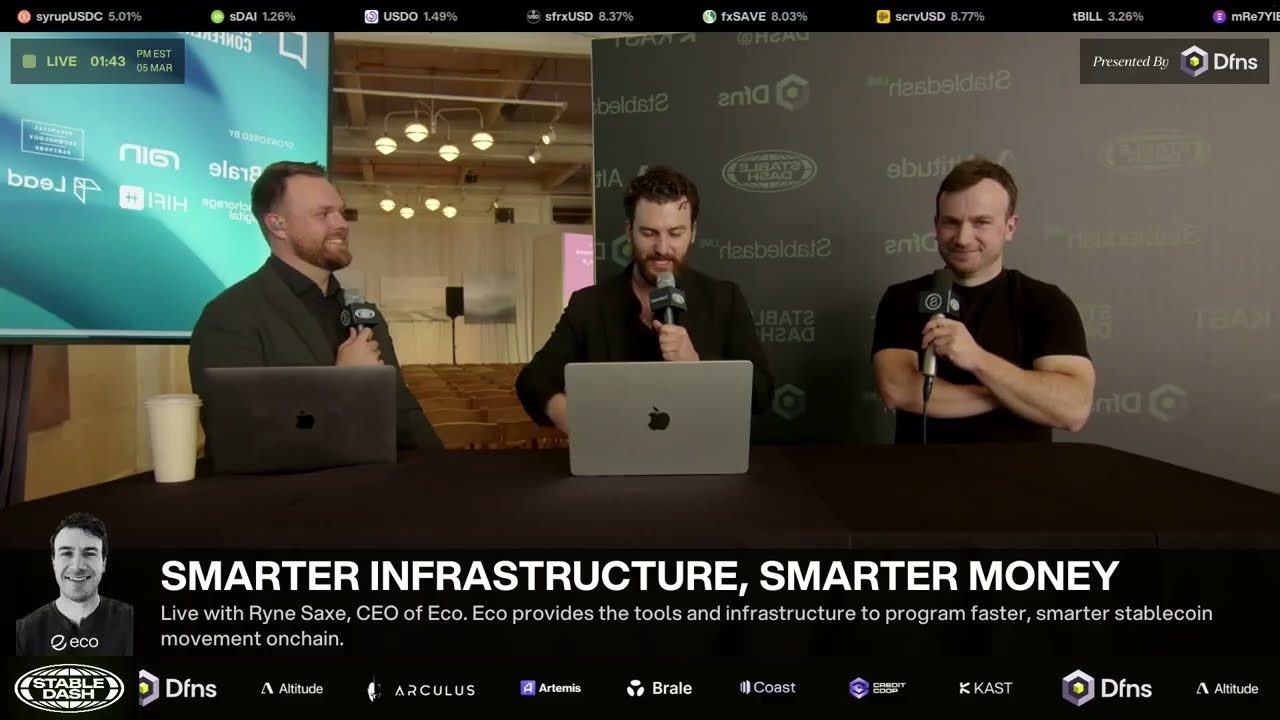
Summary
Ryne Saxe describes Eco as a transaction and liquidity network for stablecoins, with its largest institutional deals live in pilots that it cannot yet talk about.
Eco tested its crowd liquidity program by selling a $100 hat and putting the money into its first crowd liquidity pool. Founder Ryne Saxe says the fees paid out week over week are usually around $5 to $10 a week. He presents the program as one part of a network that he says moves stablecoins on chain better than anybody else.
Not a bridge
"Eco is not a stablecoin bridge," Ryne Saxe says. He describes Eco as a transaction network and a liquidity network for stablecoins. His benchmark is moving $10,000,000 with 99.9% reliability in less than ten seconds. The company also launched a retail interface, which Saxe calls a super fast send and swap bridge, and he says it did quite a bit of volume.
Saxe says speed is not the main point. He wants Eco to move money smarter by encoding how a transaction routes and settles against real time market conditions, intra block. Clients get endpoints to say why, how and when they want to move money.
“There is tons of institutional adoption in the early stages of happening that nobody can talk about because it's all stuck in pilot phase.”
Ryne SaxeCrowd liquidity
In the crowd liquidity construct, vault LPs or passive stablecoin holders allow the Eco network to flash borrow their stablecoins to fill cross chain order flow. The branded hat was the test: buyers' money went into the first pool, and fees were paid back to them every week.
Pilots waiting on rules
Ryne Saxe says some of Eco's biggest opportunities and partnerships are live in phase one, where performance is being benchmarked, and no one can talk about them yet. He says no one will activate a pilot until there is more certainty from the Clarity Act or from GENIUS rulemaking, which has gone to the agencies and is starting to happen now.
He says failure to pass Clarity would really hurt the tokenization and RWA markets. It would not be terrible for stablecoins, he says, because a fallback law has already been passed.
Who builds on it
Eco works with stablecoin issuers, blockchains, interop protocols such as LayerZero, Wormhole and Chainlink, and some DeFi protocols, according to Saxe. He expects eight or 10 stablecoin native chains to quickly stratify the wholesale stablecoin market, where money moves at real size.
Ryne Saxe started Eco in 2018 expecting stablecoins to hit in 2019. He says they took forever to happen but are now moving faster than he anticipated. He calls this "right place, right time," maybe for the first time in the company's history, even though the deals he says matter most are still waiting on regulators.
The conversation names six companies and two people.
- People
- Ryne Saxe
- Drew Rogers
- Companies
- Eco
- Chainlink
- LayerZero
- Wormhole
- Centre Consortium
- Dfns
Ask AI about this conversation

Eco is a blockchain infrastructure company whose mission is to build software that maximizes money's value. A founding contributor to the Eco Protocol, Eco powers real-time money movement across every major stablecoin and blockchain, ensuring dollars flow seamlessly across today's fragmented multichain landscape.