Stabledash Live · · 31 min
Self-Driving Finance: The Fintech Promise AI Finally Makes Possible
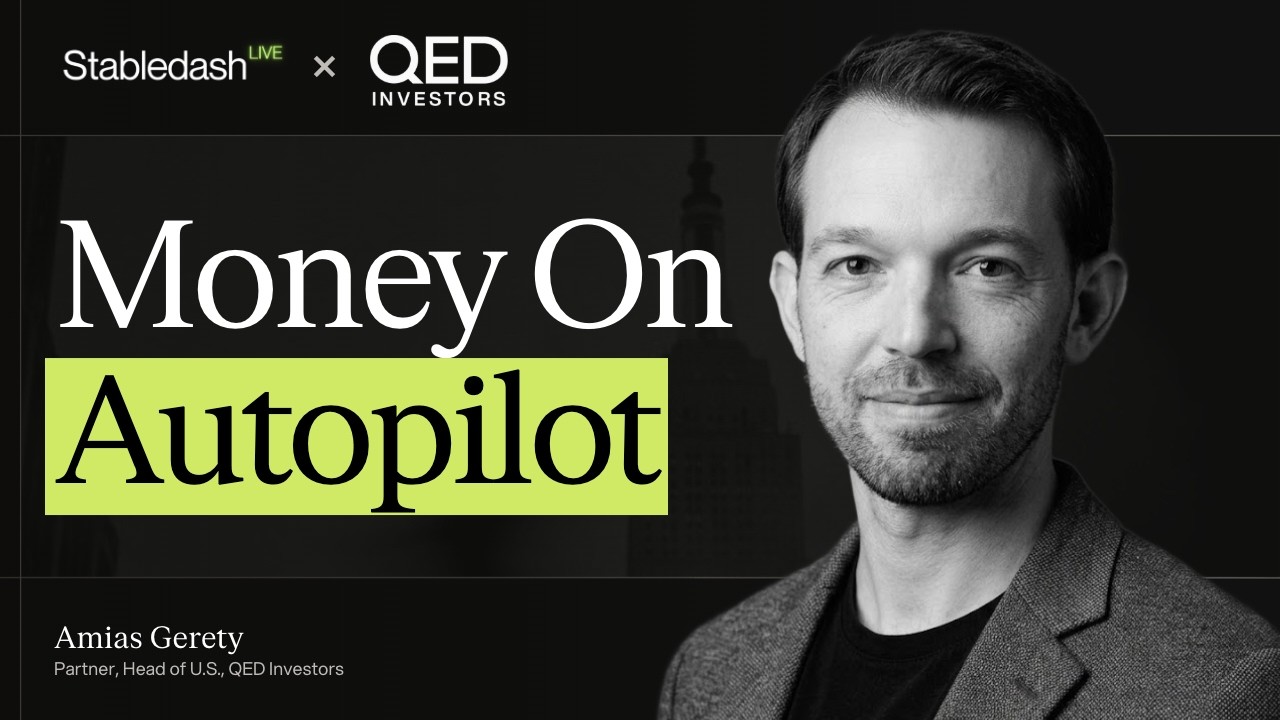
With  Amias Gerety
Key takeaways
Amias Gerety says his Bank of America account, opened when he was nine, pays under 10 basis points even at its highest rate.
Amias Gerety says fintech has been a bit disappointing for the last fifteen years, but AI and tokenization together can deliver what it first promised.
QED Investors looks for companies that bridge the power of AI with the solemn guarantees of finance, Gerety says.
Watch the episode
Summary
A QED Investors partner argues that fintech has fallen short for fifteen years, and that AI and stablecoins can now deliver on its early promises.
Amias Gerety, a partner at QED Investors, says his main bank still pays him almost nothing. He has banked with Bank of America since he was nine years old, and he says its highest deposit rate, which he holds, is under 10 basis points. On Stabledash Live he used that to make a wider argument that fintech has not yet delivered on its original promises.
Fifteen years of web forms
Amias Gerety says the industry should finally admit that fintech has been a bit disappointing for the last fifteen years. In his view, most of what it did was take web forms and put them on phones. The promise, he says, was that money could move without people filling out their name and credit card 10 times.
He says AI and tokenization are now changing that, and that tokenization has broken containment from crypto into the real world. He also notes that he explained bitcoin to the treasury secretary in 2014.
“Can you bridge the power of AI with the solemn guarantees of finance, with the mechanistic systems of record? Can you find a way to bridge those two things? Because that's where we think the present interacts with the future, and that's where the money gets made in our view.”
Amias GeretyWhat AI makes possible
Amias Gerety points to Kudos, which he says can analyze a customer's actual spending and recommend which credit card to use. Nobody in the market does that today, he says, and nobody could until AI. He also cites Collective, whose members save an average of $10,000 on their business taxes.
He warns that the hype phase is over. Two years ago founders could sell "because AI," he says, but AI is now a normal technology. He goes back to the oldest lesson of YC: build something your customers want.
The investment thesis
For QED Investors, Gerety says, the question is whether a company can bridge the power of AI with the mechanistic systems of record that finance relies on. That, he says, is where the money gets made.
Stablecoins, today and tomorrow
Amias Gerety says stablecoins created the first US dollar denominated 24/7 global payment rail, and that demand for global payments is "absolute ripping." He expects the focus to move toward control and certainty, such as giving a bigger discount when cash settles the same day instead of after five days. He also says crypto companies must worry about fraud and AML, and points to Footprint as an identity and fraud layer.
Amias Gerety's case is that AI and stablecoins matter only when they solve real customer problems, and that the winners will be the companies that pair new technology with the trust and certainty finance requires.



Kudos, Credit Karma, Collective, and Bank of America come up most.
- People
- Amias Gerety
- Drew Rogers
- Eli
- Michael Barr
- Nigel
- Sam Bobley
- Zach Fowler
- Companies
- Kudos
- Credit Karma
- Collective
- Bank of America
- Instinct
- Meow
- Footprint
- Atomic Invest
- Bitso
- Capital One
- Helix Sleep
- MaxMyInterest
- NerdWallet
- Ocrolis
- OpenClaw
- Pack Up and Go
- Uphold
- QED Investors
- ClickSwitch
- Rivo Finance