Stabledash Live · · 30 min
Mastercard's Real Product Is Trust: Stablecoin Compliance Pilot with Borderless
With  Kevin Lehtiniitty
Key takeaways
Borderless says payments companies can integrate with its network of on and off ramp providers in about two weeks instead of six or nine months.
A pilot with Mastercard has Mastercard audit providers against its franchise rules so others can rely on that attestation, starting with Infinia, Walapay and Koywe.
Kevin Lehtiniitty says the network sits at 16 providers and is about to reach 25, with quality chosen over provider count.
Watch the episode
0:00Borderless built prebuilt integrations to global on and off ramps1 of 9
Summary
Borderless CEO Kevin Lehtiniitty argues that trust, not payment rails, is what holds back cross-border stablecoin payments, and that a new Mastercard pilot is built to fix it.
Borderless, a stablecoin orchestration network, says customers can connect to its network of on and off ramp providers in about two weeks instead of six or nine months. This week the company launched a pilot with Mastercard that applies Mastercard Crypto Credential to cross-border stablecoin payments in live transactions, beginning with Infinia, Walapay and Koywe.
Trust, not rails
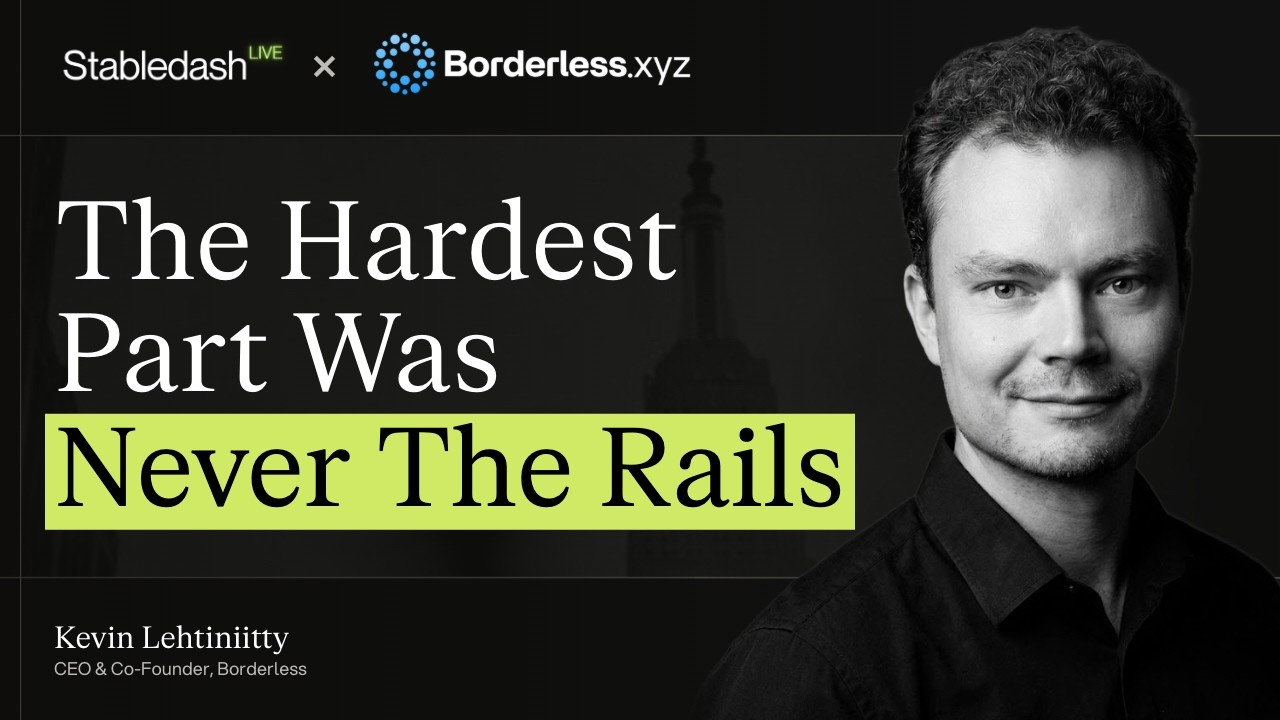
"What broke down was never the rails, it was trust," says Kevin Lehtiniitty, CEO and co-founder of Borderless. In the pilot, Mastercard audits providers against its own franchise rules so other providers can rely on that attestation instead of starting over.
Lehtiniitty argues that Mastercard's core product is not a card. "Mastercard's core product is called franchise rules," he says. He adds that the pilot was fourteen months in the making, and that without the StartPath program it would have taken five times longer just to find the right person to talk to inside Mastercard.
“What broke down was never the rails, it was trust.”
Kevin LehtiniittyFewer, better providers
Kevin Lehtiniitty says the network currently sits at 16 providers, is about to be 25, and will then grow to 40, 50 and 80. He says the vast majority of ramp providers have reliability issues, misrepresented capabilities and wrong API docs, so Borderless decided it wins by having the right providers rather than the most.
Open networks and connectivity
Lehtiniitty rejects closed-loop ecosystems built around a single issuer such as Circle or Tether, warning they would rebuild walled gardens "with blockchain lipstick." He says the rivals Borderless meets most often in RFPs are CPN and Circle's products, and that the company now sees itself as a connectivity business serving customers who orchestrate.
Publishing the data
Borderless Benchmarks reports quarterly on costs such as the price of delivering a $10,000 payment across markets. Lehtiniitty says Q2 drew on 2,960,000 observations, including intents and failed attempts, and that Borderless discloses its full methodology and data for free to build transparency.
Kevin Lehtiniitty frames all of this as a 10 to 20 year bet. He says stablecoins today are a drop in the bucket, and he hopes they become the default, with traditional payments becoming the drop in the stablecoin bucket.




Mastercard, Borderless, Circle, and Infinia come up most.
- People
- Kevin Lehtiniitty
- Drew Rogers
- Zach Fowler
- Companies
- Mastercard
- Borderless
- Circle
- Infinia
- Tether
- Braille
- Moneygram
- Samsung
- Shift4
- Sony
- Worldpay
- Koywe
- Walapay
- Dfns
- Fortress Trust
- Nuvei
- Prime Trust