Stabledash Live · · 28 min
LI.FI Intents Just Went Live: The Coordination Layer Cross-Chain Finance Was Missing
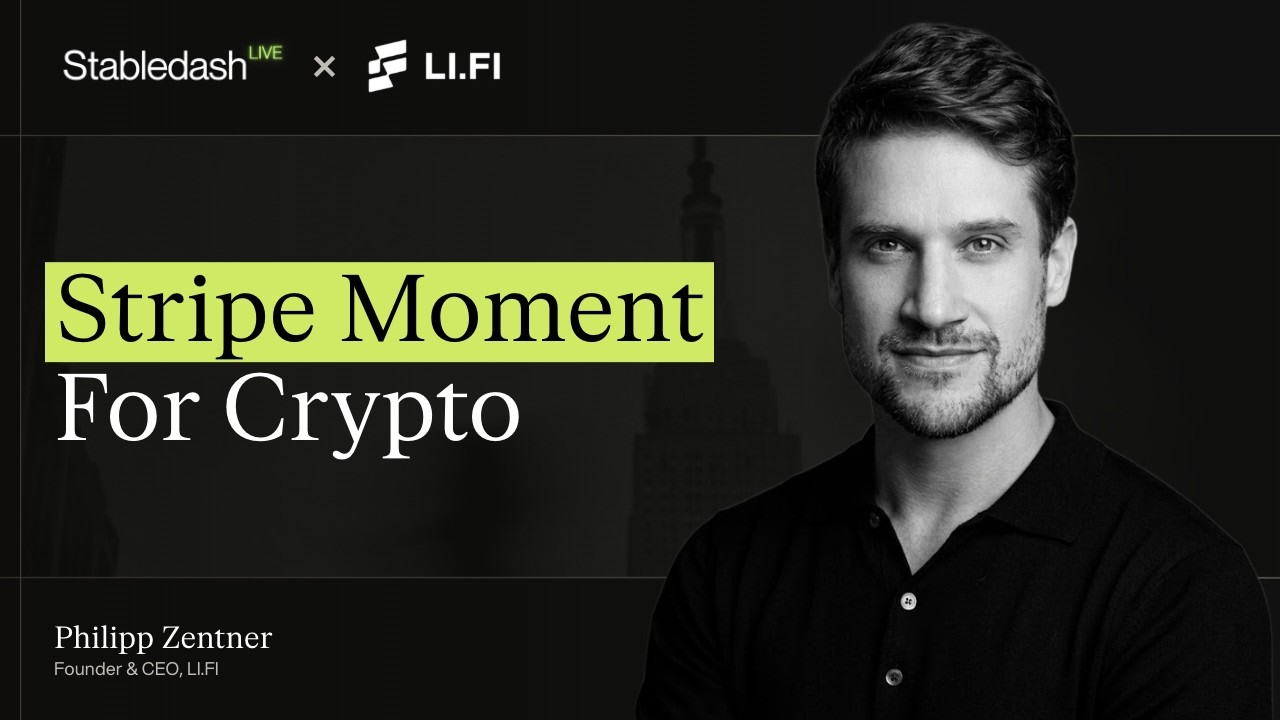
With  Philipp Zentner
Key takeaways
LI.FI has raised over $50 million to date, including a $29 million Series A extension led by Multicoin and CoinFund.
LI.FI Intents, the company's intent and solver network, went live on the day Philipp Zentner spoke, building on the acquisition of Catalyst a little over a year ago.
Philipp Zentner says at least five DEX aggregators have approached LI.FI wanting to be acquired or to shut down, part of consolidation he sees across DeFi.
Watch the episode
Summary
On the day its intent and solver network went live, LI.FI's founder pitched the company as the Stripe-style coordination layer for fragmented cross-chain finance.
LI.FI has raised over $50 million to date, including a $29 million Series A extension led by Multicoin and CoinFund. Founder and CEO Philipp Zentner said the company's intent and solver network, LI.FI Intents, went live the day he spoke on Stabledash Live. He says LI.FI works with over a thousand companies and its pipeline is full.
From aggregation to marketplace
Philipp Zentner said LI.FI bought a company called Catalyst a little over a year ago, a step he described as shifting the company "from pure aggregation to having an open marketplace." LI.FI Intents is the result of that shift. It follows LI.FI Composer, launched in February 2026 for multi-step, multi-chain DeFi orchestration.
He says the system was built abstract and modular from the start, and that its intent design can use resource locks, ERC 7683 or other escrow mechanisms. He also claims LI.FI is the only provider offering swap, bridge, swap and deposit into a vault within one transaction.
“We just help with the distribution. We are your distribution pipe.”
Philipp ZentnerThe Stripe comparison
Philipp Zentner compared the moment to Stripe fifteen years ago, when there were around 200 payment gateways that Stripe aggregated behind a simple API, and to Twilio in communications. For real-world asset issuers, he said, LI.FI acts as "your distribution pipe." The protocol is integrated by wallets and exchanges including Robinhood, Binance, Kraken, MetaMask, Phantom, Ledger, Hyperliquid, Circle and Alipay.
Consolidation and distribution
Philipp Zentner argues there is no perfect DEX aggregator because every design choice has trade-offs. He said at least five DEX aggregators have reached out wanting to be acquired or to shut down, and that the same is happening in bridging and lending. In his view, "B to C and crypto is not very loyal," so distribution decides who survives.
He also pointed to vertical integration by Phantom and MetaMask, which he said is fine for larger players but bad for smaller ones too dependent on a single integration. Acquisitions make sense, he said, when they let LI.FI use its distribution and save time to market.
Philipp Zentner expects the marketplace behind LI.FI Intents to become a coordination layer for traditional finance and for agentic commerce, and predicts LI.FI will be "a behemoth in ten years from now" as fragmentation grows.




Amazon, Stripe, Catalyst, and MetaMask come up most.
- People
- Philipp Zentner
- Drew Rogers
- Zach Fowler
- Companies
- Amazon
- Stripe
- Catalyst
- MetaMask
- Phantom
- Robinhood
- Glider
- Predicate
- Privy
- Securitize
- Sesto
- Superstate
- Twilio
- Uniswap
- LI.FI
- Alipay
- Binance
- Circle
- CoinFund
- Hyperliquid
- Kraken
- Ledger
- Multicoin
- Dfns
- Invesco
- Ondo