Stabledash Live · · 26 min
How a Wyoming County Spent $70K in Card Fees Collecting Taxes and Why Stablecoins Fix It
With  Anthony Apollo
Key takeaways
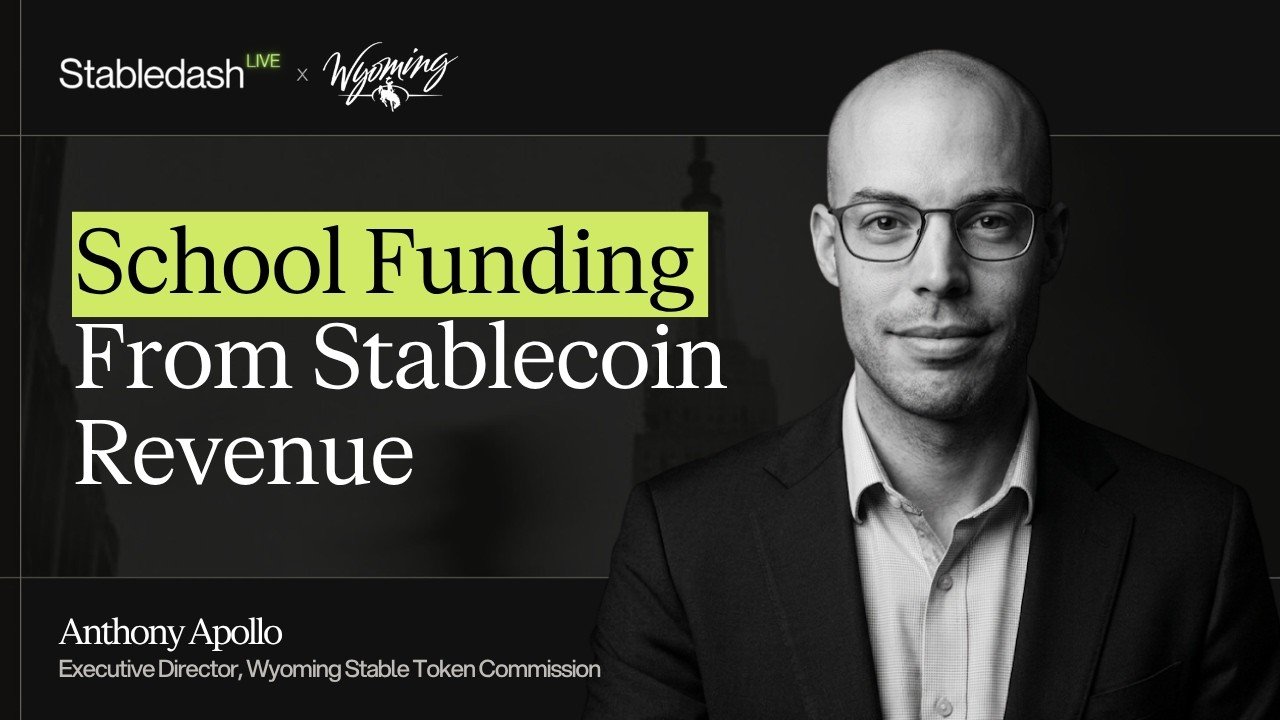
Anthony Apollo says Wyoming set up the Wyoming Stable Token Commission in March 2023 to issue what he calls the first fiat-backed, fully reserved stablecoin from a US public entity.
Converse County collected $3.4M in tax remittances in 2024 and paid $70K in card fees, costs Apollo says the token could bring down to fractions of a penny.
Wyoming's legislature gave the commission authority to coordinate issuance for other states, and Apollo says he has spoken with 20 states and four territories.
Watch the episode
Summary
Anthony Apollo says Wyoming's state-issued token falls outside the GENIUS Act, could cut tax collection fees, and may soon be issued on behalf of other states.
Wyoming created the Wyoming Stable Token Commission in March 2023 and gave it the job of issuing the WYOMINGSTABLETOKEN, which executive director Anthony Apollo describes as the first fiat-backed, fully reserved stablecoin issued by a public entity in the United States. In a Stabledash interview, Apollo set out how the token works, why he thinks federal stablecoin law does not apply to it, and how other states could use it.
How the token works
The first issuance under the WYOMINGSTABLETOKEN program is the FRONTIERSTABLETOKEN, or FRONT token, which is the one now in circulation. Anthony Apollo says reserves go into US Treasury securities with 365 days or less of maturity and repurchase agreements with 30 days or less. Revenue is meant to be swept each quarter into the state school foundation program, which he calls "a public goods project for the state."
“Everything we do is public. If you wanna just copy and paste what we've done, go for it. If you wanna work with our organization, our agency, our commission to do it on your behalf, we're more than happy to facilitate that.”
Anthony ApolloOutside the GENIUS Act
Anthony Apollo says that in his opinion the WYOMINGSTABLETOKEN is not subject to the GENIUS Act, because the law's list of permitted issuers covers banks, trusts, fintechs and other business entities but not sovereign issuers. He also warned against adding cash equivalency or yield-bearing features, saying the token could start to look like a currency, which states cannot issue, or like debt.
The cost of collecting taxes
Anthony Apollo cited testimony from the Converse County treasurer: the county collected $3,400,000 in tax remittances in 2024, and its residents paid $70,000 in credit card processing fees. Apollo says the stable token infrastructure built so far can get those fees down to fractions of a penny.
Issuing for other states
After a recent amendment, the Wyoming Stable Token Commission has explicit authority to coordinate issuance on behalf of other states. Anthony Apollo says he has spoken with 20 states and four territories, and he expects states to sign up to Wyoming's infrastructure over the rest of 2026. Other states can copy Wyoming's public work or hire the commission to issue for them, he says, but Wyoming will not manage their tokens. They would need their own wallet infrastructure and staff trained in digital asset management.
Elsewhere, the Bank of North Dakota is putting out the ROUGHRIDERCOIN with Fiserv. It is built for settlement between banks inside North Dakota, not for public or retail use.
CLARITY Act moves
While the show was live, the CLARITY Act advanced out of the Senate Banking Committee 15-9, with two Democrats voting in favor. Anthony Apollo expects it to pass a Republican-controlled Senate. He noted that the Senate version includes an ancillary asset test that he does not think is in the House bill, so the two versions will need to be reconciled. Host Drew Rogers said he is hearing of a desire to have the president sign it on July 4.
In Apollo's account, Wyoming is setting itself up as the place other states go to issue their own stablecoins. It is a sovereign issuer that he says sits outside the GENIUS Act, its revenue goes to schools, and it now has explicit legal authority to issue for other states. He expects those arrangements to come together over the rest of 2026.



Bank of North Dakota, Senate Banking Committee, Wyoming Stable Token Commission, and Fiserv come up most.
- People
- Anthony Apollo
- Drew Rogers
- Joel Shell
- Mark Gordon
- Stephanie Chan
- Caitlin Long
- Cynthia Lummis
- Travis Fitzwater
- Zach Fowler
- Companies
- Bank of North Dakota
- Senate Banking Committee
- Wyoming Stable Token Commission
- Fiserv
- Crypto in America
- Custodia
- Dfns