Stabledash Live · · 28 min
Crossmint's General Counsel on AI Agents, Liability, and MiCA 2.0
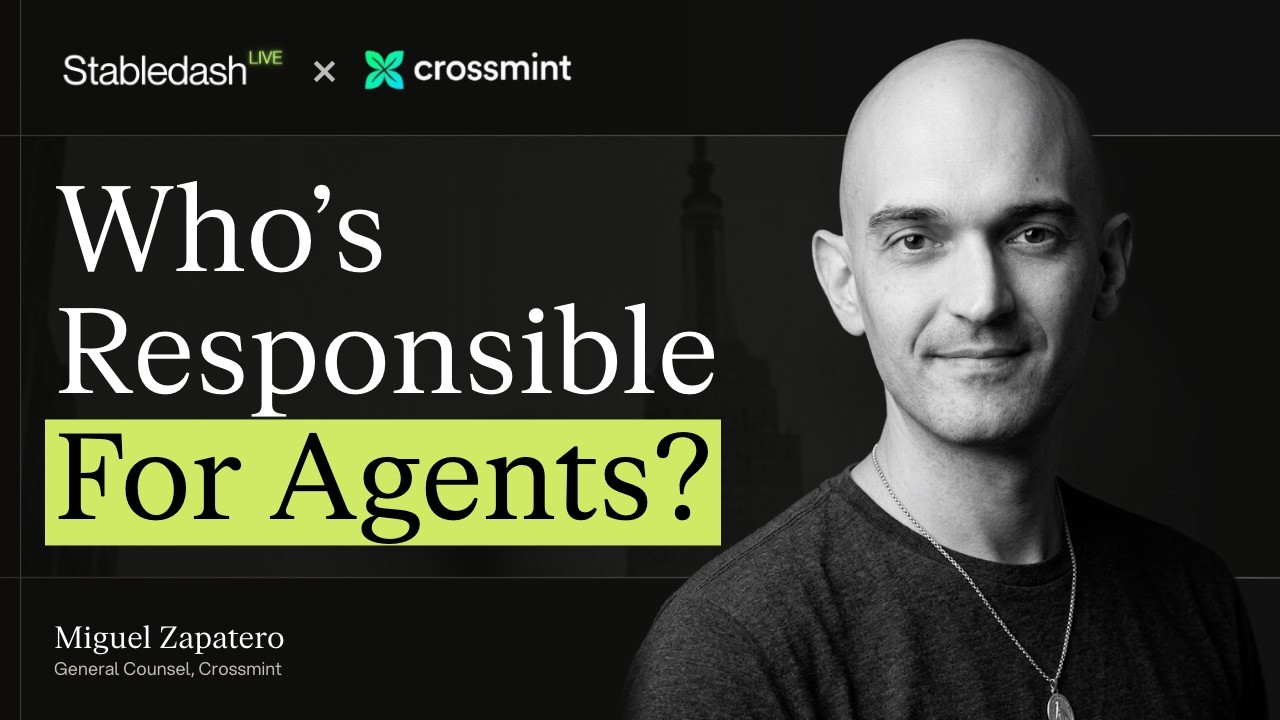
With  Miguel Zapatero
Key takeaways
Crossmint raised $23.6 million in a round led by Ribbit Capital, with a strategic investment from Circle Ventures.
Miguel Zapatero says that when an AI agent moving a user's money goes wrong, nobody currently knows who is liable, and he argues agents deserve their own regulation.
He wants MiCA 2.0 to set an agent liability framework and let service providers offer yield on stablecoins, but he does not expect clear progress before 2028 at the earliest.
Watch the episode
Summary
Crossmint's general counsel says nobody knows who is liable when an AI agent mishandles user money, and wants MiCA 2.0 to answer that.
Crossmint raised $23.6 million in a round led by Ribbit Capital, with a strategic investment from Circle Ventures. Its General Counsel, Miguel Zapatero, says the next big open question in payments has no answer yet under MiCA: when an AI agent moves a user's money and something goes wrong, nobody knows who is liable.
From NFTs to licensed finance
Miguel Zapatero joined Crossmint from big law in Spain during the company's 2022 fundraising phase. He led its move from an unregulated NFT platform to a licensed financial institution, as the company shifted to stablecoins and broader infrastructure. Crossmint is now authorized under MiCA and powers infrastructure for Western Union and MoneyGram stablecoin products across 40+ blockchains.
"Crossmint is a financial institution now, not a crypto institution," Zapatero says, adding that the distinction changed every conversation with clients, counterparties and regulators.
“Crossmint is a financial institution now, not a crypto institution, and that distinction changed every conversation with clients, counterparties, and regulators.”
Miguel ZapateroThe cost of a license
After a June 2025 requirement from ESMA, firms offering stablecoin payment services also needed a PSD2 payment license, so Crossmint got one. Zapatero puts its capital requirements at €300,000. He says only nine or 10 crypto asset service providers in Spain are licensed under MiCA, and six of them are banks. Host Drew Rogers noted that Tether chose to leave the region rather than seek compliance. Zapatero expects fewer new entrants after 2026.
What MiCA left out
Zapatero lists the gaps in MiCA. It gives no clarity on what counts as sufficiently decentralized for DeFi, it leaves NFTs out completely, and it bans yield on stablecoin deposits. Stablecoin deposits also lack the guarantee that covers consumer fiat deposits in Europe up to €100,000.
For MiCA 2.0, his first request would be to let service providers offer yield on stablecoins. He also wants a framework that sets who is responsible when agents fail. "Agents in general deserve their own regulation," he says, because they are dealing with users' money.
Zapatero says regulatory clarity on stablecoins and payments has improved since 2022. He sees agent liability as the next problem to solve, but he does not expect MiCA 2.0 to bring clear changes before 2028 at the earliest, and he says much is still to be discussed.


Crossmint and Coinbase come up most.
- People
- Miguel Zapatero
- Drew Rogers
- Zach Fowler
- Companies
- Crossmint
- Coinbase
- Circle Ventures
- Moneygram
- Ribbit Capital
- Tether
- Western Union
- Dfns