Stabledash Live · · 23 min
AI Agentic Compliance and the Coming Stablecoin Margin Collapse: Zack Martin
With  Zack Martin
Key takeaways
Zack Martin of CipherOwl predicts stablecoin transactions will grow sharply while margins collapse, so issuers will need a different business model built on automation.
He argues that adding AI agents to legacy compliance infrastructure fails, and says CipherOwl has built AI investigation features into its tool from the beginning over the last two years.
He recommends issuers use two vendors, one of the main incumbents such as Chainalysis or TRM plus CipherOwl as the backup.
Watch the episode
Summary
A former Chainalysis early hire says issuers need agent-first compliance tools, two vendors and a crawl-walk-run rollout as transaction volumes grow.
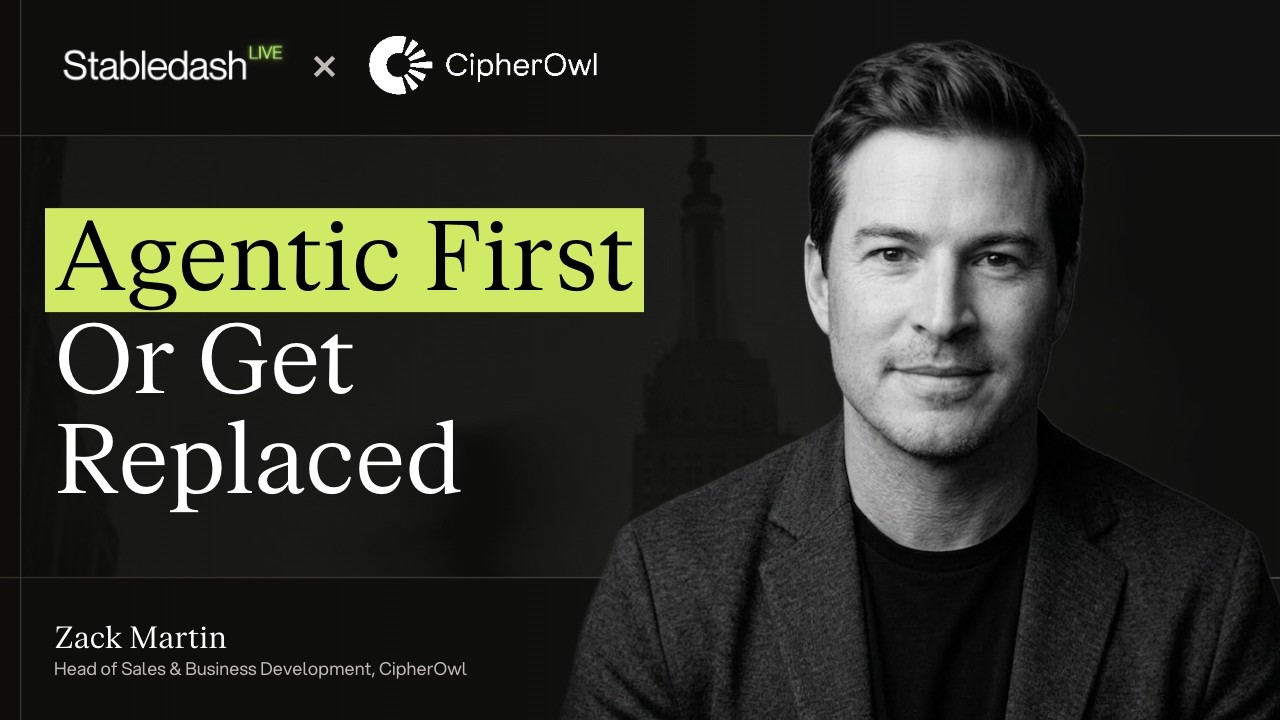
Zack Martin, Head of Sales and Business Development at CipherOwl, predicts that stablecoin margins will collapse even as transaction volumes grow, pushing issuers toward automated compliance. "We're gonna see massive amounts of transactions, but those margins are gonna collapse," he says. He was one of the first Chainalysis hires on the West Coast.
From Coinbase to CipherOwl
Zack Martin says his earlier team was selling into Coinbase, which kept building everything "better, faster, cheaper internally." When that team decided to spin out, it called him, and he joined. He says the CipherOwl founders came from autonomous vehicle data systems before moving to onchain activity.
“Right now, screening is a tax on the industry. I think that if you're paying in absorbent amounts of per wallet screen, it's just not gonna help scale the industry and it's going to stand in the way of adoption.”
Zack MartinAgent-first, not bolted on
Zack Martin says the problems seen at Salesforce and Adobe show that adding agents on top of existing infrastructure does not work, and that companies need to be agentic from the beginning. He says CipherOwl put AI auto-graphing, auto-narratives and auto-risk descriptions into its tool over the last two years, and that Chainalysis and TRM have since added similar tools.
The company's SR3 framework covers four modules: screen, reason, research and report. Martin says each address label comes with an audit trail and a confidence score, so "gone will be the days where it's a black box system," and that every endpoint is an API.
Scale and regulation
Zack Martin calls wallet screening "a tax on the industry" that stands in the way of adoption. He expects large institutions such as Visa and Charles Schwab will not be able to scale SAR filing with human staff, saying a team of 5,000 investigators "is not gonna be reasonable." Drew Rogers said the Clarity Act is creating tailwinds that make such tools a must for larger institutions.
Two vendors and a rollout path
Zack Martin describes Chainalysis as "buying a logo of reputation" and TRM as the second biggest player, and says Elliptic, a data provider based overseas, can be harder for US entities. He advises issuers to avoid a single point of failure by picking an incumbent and bringing in CipherOwl as the backup. For issuers starting from scratch, he lays out monitoring first, then alerting, then action, with alerts sent to phones, Slack or Teams.
Martin's argument is that falling margins and growing agent-driven volume will make manual compliance too costly. CipherOwl is positioning itself as an API-based, agent-first second vendor next to the incumbents, delivering monitoring and alerts wherever issuers work.


Coinbase, Canary, Salesforce, and Chainalysis come up most.
- People
- Zack Martin
- Drew Rogers
- Alexis
- Charles (Rain)
- Emily (Coinbase President)
- Greg Bell
- Leo
- Ming
- Nikhil
- Zach Fowler
- Companies
- Coinbase
- Canary
- Salesforce
- Chainalysis
- Predicate
- Rain
- TRM
- Adobe
- Charles Schwab
- Elliptic
- Bear Stearns
- Hedera Foundation
- William Blair
- CipherOwl
- Visa Ventures
- Arbitrum
- Dfns
- Ernst & Young