Stablecoin Conference · · 33 min
Inside Brazil's New Crypto Licensing and Compliance Rules
With  Caio Barbosa
Key takeaways
Caio Barbosa says Lumx raised a $3.4M seed round in October 2025 and has since closed an extension with new investors that it has not yet announced.
Under Brazil's new VASP framework, licenses require minimum capital of $2M to $3.5M and applications are due by October 29, and two weeks before the conversation no one had applied.
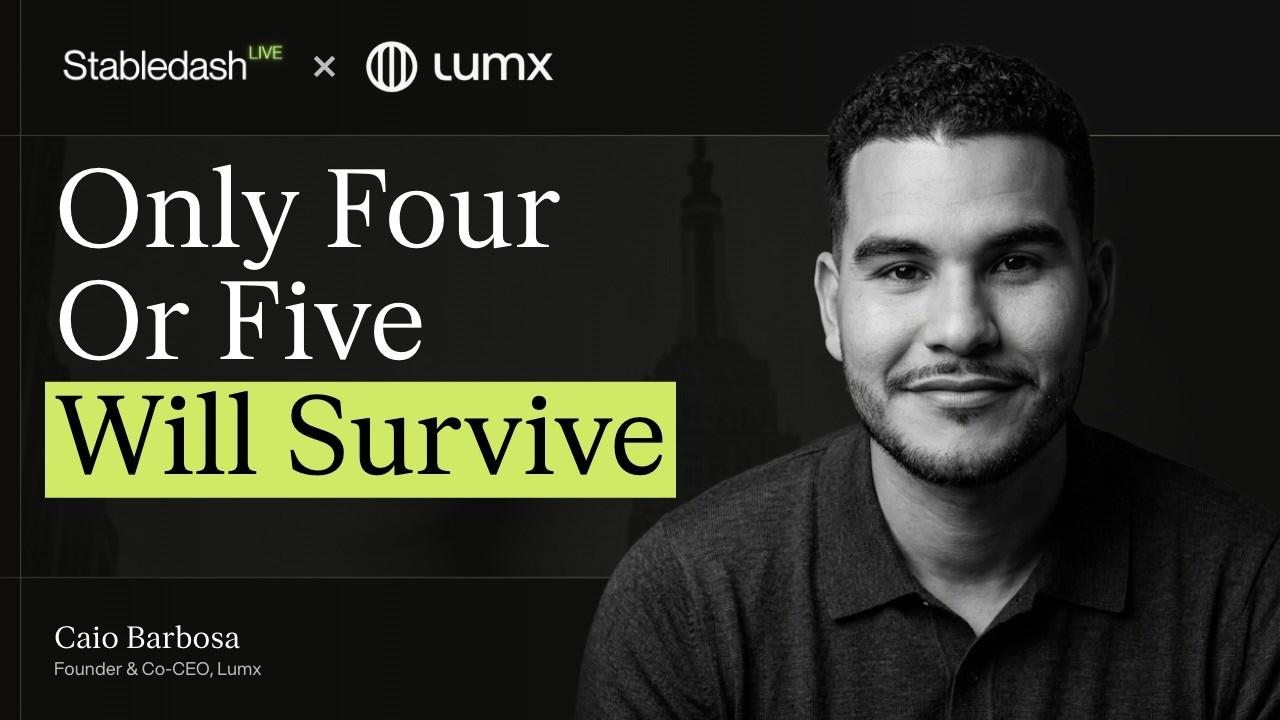
Caio Barbosa expects only four or five local players to survive the shakeout, with banks as the biggest winners because they face no transaction limits.
Watch the episode
Summary
The Rio de Janeiro stablecoin API company is putting licensing ahead of new features, and its founder expects Brazil's new rules to leave only a handful of local players.
Lumx, a stablecoin API for cross-border payments, raised a $3.4M seed round in October 2025, founder Caio Barbosa says. He adds that the company has also completed an extension round with new investors that it has not yet made public. The funding comes as the Brazil Central Bank VASP Framework forces companies to choose between paying for a license and leaving the market.
A bank on the cap table
Lumx offers an API that lets businesses collect payments, send payouts worldwide and give their users named accounts. Caio Barbosa says Lumx is the only stablecoin player with a bank on its cap table: BTG Pactual, which is also its main liquidity provider in Brazil. He says 90% of customers are mainstream businesses, fintechs and platforms rather than crypto-native companies.
One of those customers, Log Comics, launched global accounts built on the API in Q1 2026, so Brazilian importers can pay Chinese exporters through USD named accounts. Caio Barbosa says Log Comics already serves one third of Brazil's FX volume, and that 60 to 70% of that volume comes from imports and exports.
“The reality is the market is being cleaned up. It's being cleaned up. So, basically, like, when you take a look at the whole market, a few players will survive. Others are literally selling right now.”
Caio BarbosaThe tax push
The IOF foreign exchange tax went from 0.38% to 3.5%. Caio Barbosa says that, depending on how they are structured, stablecoin flows can run without the IOF. He adds that it is now common for a Brazilian business to pay a partner in Hong Kong directly in stablecoins.
Steep licensing bar
The Brazil Central Bank VASP Framework divides licenses into intermediary, custodian and exchange categories. Minimum capital starts at $2,000,000 and can reach $3,500,000. To use the transition rules, a company had to be operating by February 2. VASPs are limited to $100k per transaction and FX brokers to $500k, while banks have no limit. The travel rule only applies in phase two, in 2027.
Applications for a VASP License close on October 29. Two weeks before the conversation, the government said no one had applied yet.
Licensing over features
Caio Barbosa says he has spent at least 70% of his time over the last three months on regulation. Lumx sees the license as one of its main moats, and he says the company is giving up some revenue and new features now so the license pays off in the medium term.
Caio Barbosa says the market is being cleaned up. Some players are selling, and global companies such as Conduit have left Brazil because of the barriers. He predicts only four or five local players will survive and that banks will gain the most. Lumx is betting that its fresh capital and its bank backing put it among those survivors.


Agora and Conduit come up most.
- People
- Caio Barbosa
- Companies
- Agora
- Conduit
- Lumx
- Log Comics
- BTG Pactual
- Dfns