Stablecoin Conference · · 30 min
Building the Internet for Money: Inside Lightspark's Grid
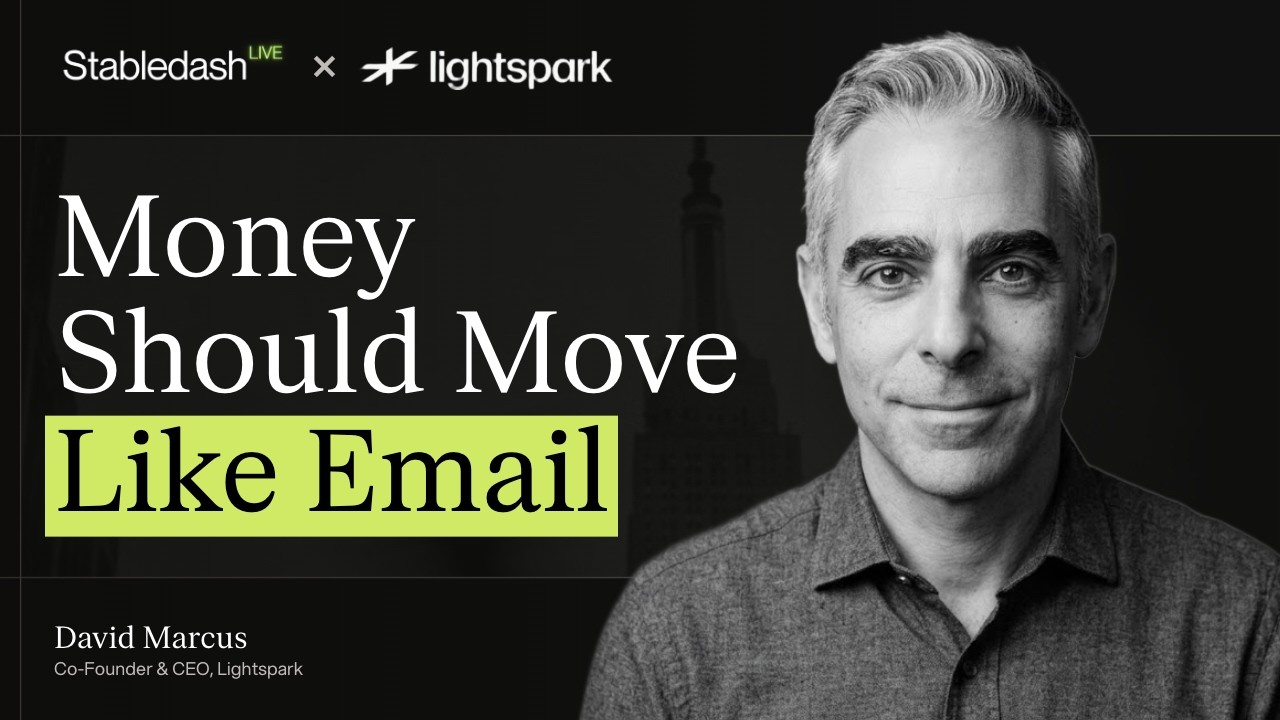
With David Marcus
Key takeaways
Lightspark acquired Strigo last year, now Lightspark Payments Europe, which gives it direct SEPA network participation.
Lightspark Grid is live in 65 countries and expanding to 70, with China being added this week.
David Marcus expects the next nine months to show platforms moving from using stablecoins for payouts to owning their money-movement infrastructure.
Watch the episode
Summary
David Marcus says the European deal, a Visa principal membership and a Grid network in 65 countries are part of a plan to build an open internet for money.
Lightspark acquired Strigo last year, and the business, now Lightspark Payments Europe, gives the company direct SEPA network participation, co-founder and CEO David Marcus says. He says it will be the company's EMI entity in Europe once its license is converted, which he expects will probably happen soon. The deal adds to a network, Lightspark Grid, that he says is live in 65 countries.
Three connected products
Lightspark Grid handles real-time money movement. David Marcus says a customer who opens an account can send money in local currencies to 65 countries in real time on the same day, and that the network is expanding to 70. He says hundreds of wallets and neobanks use Grid as their money-movement backbone, for payouts, pay-ins and virtual named accounts.
Grid Global Accounts, announced six weeks before the interview, gives platforms that do many payouts a branded dollar or multicurrency account with a Visa card that can be spent at 175 million merchants. Spark, Lightspark's Bitcoin layer two, moves stablecoins and Bitcoin in real time.
“It's like payments businesses are, like, are slingshots. Right? It's like it it feels like really, really, really, really hard. You pull, pull, pull, pull, but then you get to a point where you have enough capabilities that it feels like the the energy gets, you know, moved to the other side.”
Europe, China and cards
Outside Europe, David Marcus says Lightspark has built redundant routes into every payment network, because aggregators often deliver less than they promise. This week the company is adding China, which he calls really hard to do for consumer and business flows in Yuan. He also says Lightspark is becoming a Visa principal member and will enable stablecoin-backed card issuance in 100 plus countries.
An open network
David Marcus describes a long-running frustration that money does not move on the internet like other content. He says Lightspark built Lightspark Grid as an open network it does not own or control, and that he would rather build something that outlasts this generation than chase a sale. Grid supports stablecoins such as USDC and USDT across blockchains, and the company partners with Brale on USDB while letting platforms bring their own stablecoin.
David Marcus compares payments businesses to slingshots: years of pulling before the energy moves to the other side. His bet is that by linking domestic payment systems over one low-cost real-time rail, Lightspark can become the settlement backbone for global payments.



Lightspark, Agora, Coinbase, and Infinite Game come up most.
- People
- David Marcus
- Davy Strausser
- Alex Gillette
- Christina Potter
- Simon Sinek
- Companies
- Lightspark
- Agora
- Coinbase
- Infinite Game
- Adyen
- Strigo
- Bitso
- Visa Ventures
- Brale
- Dfns