Research · · 29 min
Jess Houlgrave on WalletConnect Pay, the CLARITY Act, and Stablecoin Self-Custody
With  Jess Houlgrave
Key takeaways
Jess Houlgrave argues the CLARITY Act has one glaring flaw: it does not protect self-custodial infrastructure.
She says key management has nothing to do with compliance, and that KYC can cryptographically link a wallet address to an identity.
WalletConnect Pay, launched in March 2026, is rolling out through Ingenico terminals and is live with the Argentine peso and Brazilian real.
Watch the episode
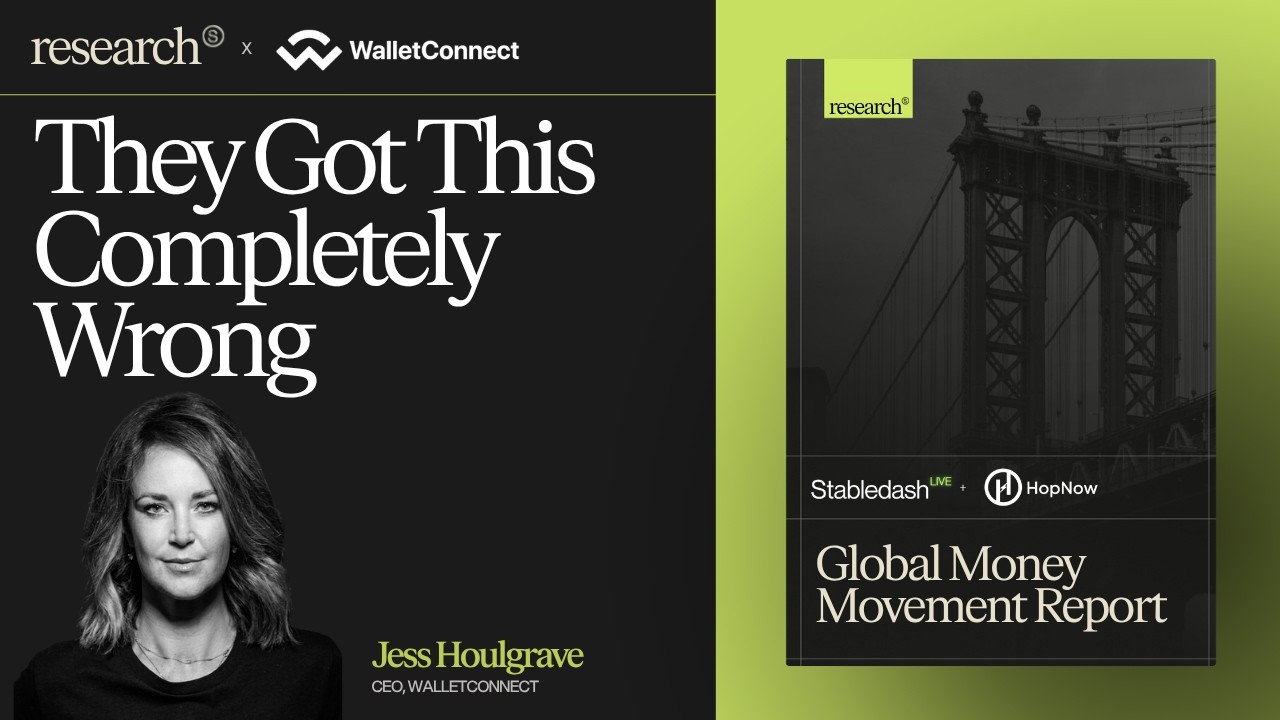
0:00Self-custody matters for people with fragile financial institutions1 of 8
Summary
Houlgrave argues that how keys are held is a separate question from regulation, as WalletConnect Pay moves into local-currency stablecoin checkout.
Jess Houlgrave, who joined WalletConnect as COO, moved to CFO and now runs the company as CEO from Lisbon, is making the case that self-custodial wallets can meet regulators' goals. In a June 3, 2026 op-ed she argued the CLARITY Act does not protect self-custodial infrastructure. The bill passed the House in July 2025 and cleared Senate Banking in May 2026.
A flaw in the bill
Jess Houlgrave's argument on the CLARITY Act is that regulating software providers like banks or brokers pushes builders away from compliant ecosystems rather than toward them. She ties her interest in self-custody to financial inclusion, pointing to billions of people where institutions are fragile and "people's assets get frozen" without due process.
She cites the Bank of England, which said initially that self-custody wallets would not be able to hold a British CBDC, though she says it has since walked back on this a little.
“The way that the keys are stored has actually nothing to do with the assets that sit inside that wallet or how that wallet interacts and behaves. When you're talking with a regulator about what they're trying to achieve when they say something like, you know, I want to... Let's let's say the Bank of England example. The CBDC cannot be held by a self custody asset. Why? Well, we don't know who owns that. Wrong. You can actually secure a wallet address or... And the the control of that keys to an identity if you have a... If you have the technology to put someone through a KYC process and then to to cryptographically link that wallet address to that identity, problem solved.”
Jess HoulgraveKeys versus compliance
Jess Houlgrave says the way keys are stored has nothing to do with the assets in a wallet or how it behaves. If a provider can put someone through KYC and cryptographically link a wallet address to that identity, she says, "problem solved." She also points to the ERC-3009 token standard, which mimics the auth and capture flow of traditional payment systems and prevents funds being sent to the wrong wallet.
Local stablecoins at checkout
Jess Houlgrave expects the localization of stablecoins to be a big theme for the next two years, calling it the next very obvious move for the space.
WalletConnect Pay, the stablecoin and crypto checkout product WalletConnect launched in March 2026, is rolling out through Ingenico terminals for physical retail, with a projected $400 billion in annual Total Network Volume. Houlgrave says it is live in Argentina with the peso and with the Brazilian real, is going live in some Asian countries, and will be live with some merchants on Japanese yen pretty soon.
Jess Houlgrave says she is probably speaking with regulators more than she ever has before. Her argument is that self-custody and compliance do not have to be traded against each other, and she wants the CLARITY Act to say so before builders move away from compliant ecosystems.




WalletConnect, Bank of England, Movement, and Ingenico come up most.
- People
- Jess Houlgrave
- Drew Rogers
- Rob
- Zach Fowler
- Companies
- WalletConnect
- Bank of England
- Movement
- Ingenico
- Northern Rock
- Revolut
- American Banker
- Circle
- Dfns
- Hopnow
- PayPal


