Research · · 28 min
Cross-Border Payments Run on Cash Parked in Advance: There Is No Single Global Ledger for Money
With  Brent Traidman
Key takeaways
XFX, launched in September 2023, is approaching $10 billion in annualized volume in the US, Mexico and Colombia, and plans Brazil, Singapore and Europe before year-end.
Santiago Alvarado says Correspondent Banking traps between $4 trillion and $27 trillion just to guarantee execution, and cites the Bank for International Settlements as tying 80% of money movement costs to tied-up capital.
XFX acts as a principal dealer with 15-minute settlement SLAs and no prefunding, which Alvarado says lets a payments firm grow from $100 million to $1 billion a month without a 10x larger capital base.
Watch the episode
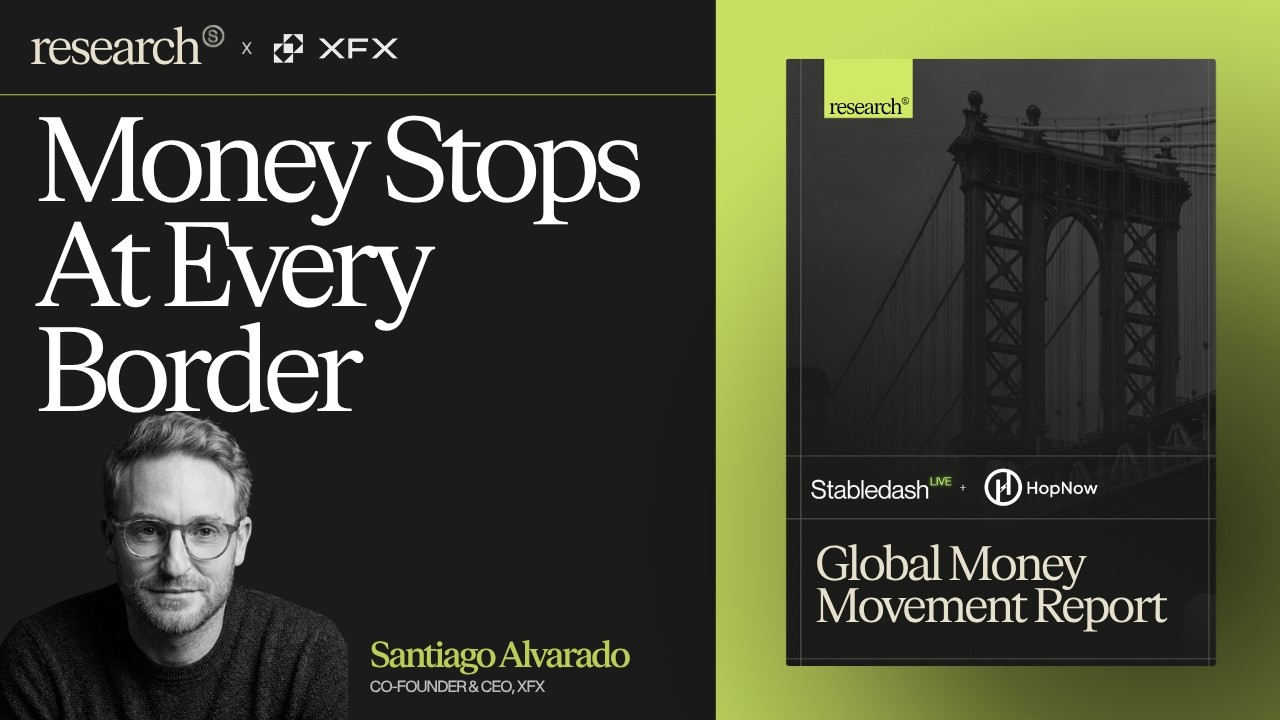
0:00Bitso's B2B payments work led to founding XFX1 of 9
Summary
Co-founder Santiago Alvarado pitches XFX as a principal dealer that cuts the capital cross-border payments lock up, which he calls the main cost of moving money globally.
XFX is approaching $10 billion in annualized volume, co-founder Santiago Alvarado says, with operations in the US, Mexico and Colombia. The company launched in September 2023 to provide liquidity for cross-border payments and FX settlement.
From Bitso to XFX
Santiago Alvarado joined Bitso six years ago, when it was mostly a retail exchange, to launch its B2B payments business. He started XFX after that.
“The correspondent banking system basically traps, depending on the source, between 4,000,000,000,000 to $27,000,000,000,000 just to guarantee execution”
No global ledger for money
Alvarado's starting point is that there is no single global ledger. Central banks such as the Fed and Banxico each run their own, and they are connected through Correspondent Banking. He says that system traps, depending on the source, between $4 trillion and $27 trillion just to guarantee execution.
He points to the Bank for International Settlements among the sources for the view that 80% of the cost of global money movement relates to tied-up capital. He also argues that automated market makers only work for long-tail assets and could never serve deep markets like FX, because they would have to rebuild correspondent banking on-chain.
Principal, not agent
XFX operates as a principal dealer holding inventory risk across currencies and venues to meet fifteen-minute settlement SLAs, running delivery versus payment with no prefunding required, Alvarado says.
He says that changes the math for payments institutions. A firm processing $100 million a month that wants to reach $1 billion would otherwise need to grow its capital base 10x linearly. "With us, you don't need to do that," he says.
Expansion and tokenized treasury
XFX plans to launch in Brazil, Singapore and Europe before the end of the year. In Mexico it is starting to use EtherFuse's MXNB stable bond for its own treasury, and may find other uses for it later.
Alvarado expects tokenized money markets and stable bonds to let the industry rearchitect settlement chains for global money movement, which he calls a massive unlock. For XFX, the case comes down to moving more volume with less parked capital, and the company is already testing that idea in its own treasury.




XFX, Bitso, Etherfuse, and Airwallex come up most.
- People
- Santiago Alvarado
- Brent Traidman
- Drew Rogers
- Zach Fowler
- Companies
- XFX
- Bitso
- Etherfuse
- Airwallex
- Rain
- Bank for International Settlements
- Circle
- Dfns
- Hopnow


