Key takeaways
Joe Flanagan says Maple Finance manages a loan book of $2 billion and $4.5 billion in total assets, which he says makes it the second largest institutional lender in crypto, behind Tether.
After FTX, Maple Finance moved all underwriting in-house and switched to fully secured lending only, at a time when its deposits dropped from $1 billion to $15 million.
Through Maple Embed, Maple's yield is offered inside Robinhood Earn, and Joe Flanagan says borrowing will be added next.
Watch the episode
Summary
Rebuilt after FTX around in-house underwriting and secured loans only, Maple is now selling its yield products to fintechs and wants AI agents to do more of its credit work.
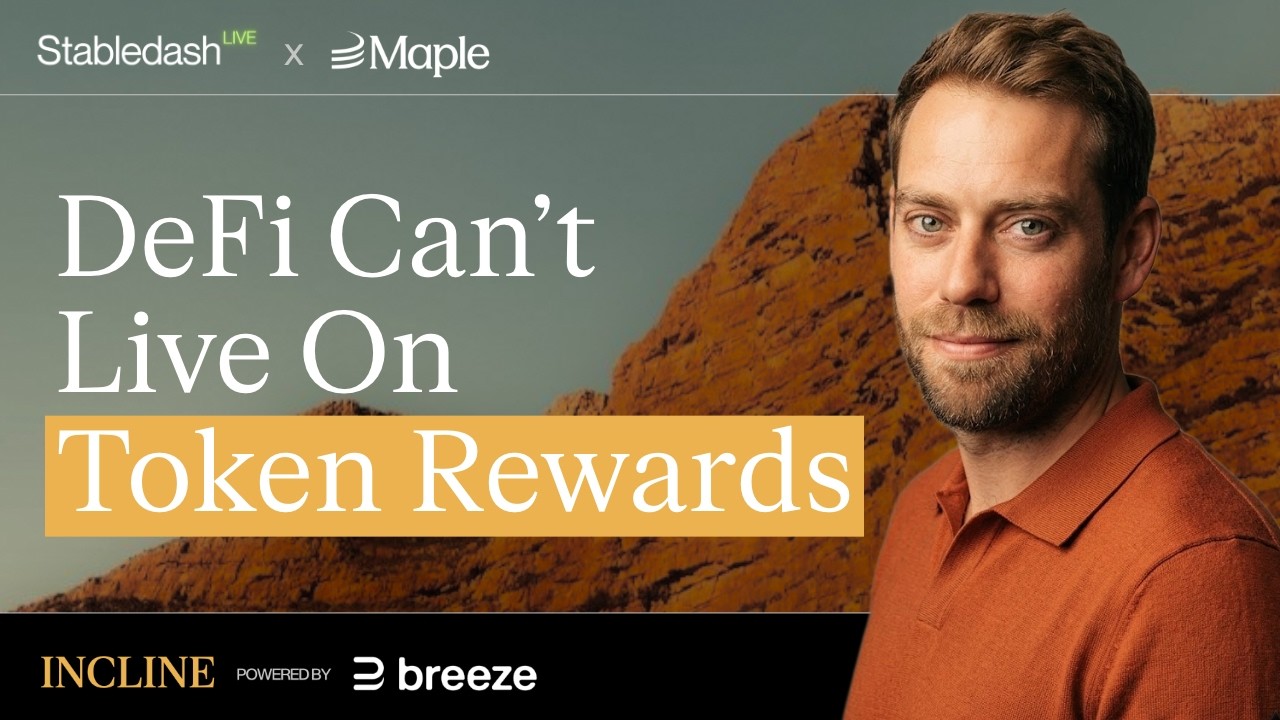
Maple Finance manages a loan book of around $2 billion and $4.5 billion in total assets under management, co-founder Joe Flanagan said on Stabledash Live. He describes the firm, which he and Sid started in Australia seven years ago, as an on-chain asset manager for which "lending is our bread and butter." He says it is now the second largest institutional lender in crypto, behind Tether.
Rebuilding after FTX
Joe Flanagan says Maple Finance made two major changes after FTX. It brought all underwriting and risk management into its own systems, and it moved to only fully secured, over-collateralized lending. Deposits had fallen from $1 billion at the peak of the 2021 to early 2022 cycle to $15 million. Today every dollar lent is managed in Maple HQ, an internal risk hub built on smart contracts and AI.
“One of the core values of blockchain technology is that a trustless transaction can exist. And trustless doesn't mean that I don't trust you, it's that means that I don't have to trust you”
 Joe Flanagan
One hub, many chains
Maple Finance picked Ethereum as its hub rather than deploying its contracts on many chains, and it partnered with Chainlink to pull cross-chain deposits into that hub. Its Syrup products are offered in several places: Syrup USDG on Robinhood, Syrup USDC on Solana and Syrup USDT on Plasma.
Selling yield to fintechs
Maple Embed puts Maple's products directly in front of fintechs' existing customers. Working with Morpho, Maple is built into the Robinhood Earn experience. Joe Flanagan says the next step is to let those customers borrow too. That will start with loans backed by assets like Bitcoin, then move to other tokenized assets and later to cash flow loans. He also plans asset-backed securitization of fintech loan books. In his view, yield has to come from real economic activity rather than token incentives.
Agents as underwriters
Maple already uses AI agents to track the price of Bitcoin and run scenarios on volatile collateral such as XRP. Joe Flanagan expects that within five to ten years, agents will verify borrower information and make initial credit decisions. He says real-time monitoring would let lenders step in before loans go bad. For trading firms, he pictures agents dealing directly with other agents, for example offering to borrow at five and a half percent.
Joe Flanagan points out that stablecoin payment volume in 2025 was twice that of Visa. He argues that on-chain payment histories could let small businesses, including those in emerging markets, borrow against their records, linking crypto lending to the wider financial system.




Robinhood, Morpho, Altitude, and Solana Foundation come up most.
- People
- Joe Flanagan
- Sid
- Drew Rogers
- Zach Fowler
- Companies
- Robinhood
- Morpho
- Altitude
- Solana Foundation
- Stripe
- Coinbase
- Steakhouse
- Maple Finance
- Tether
- Chainlink
- Revolut