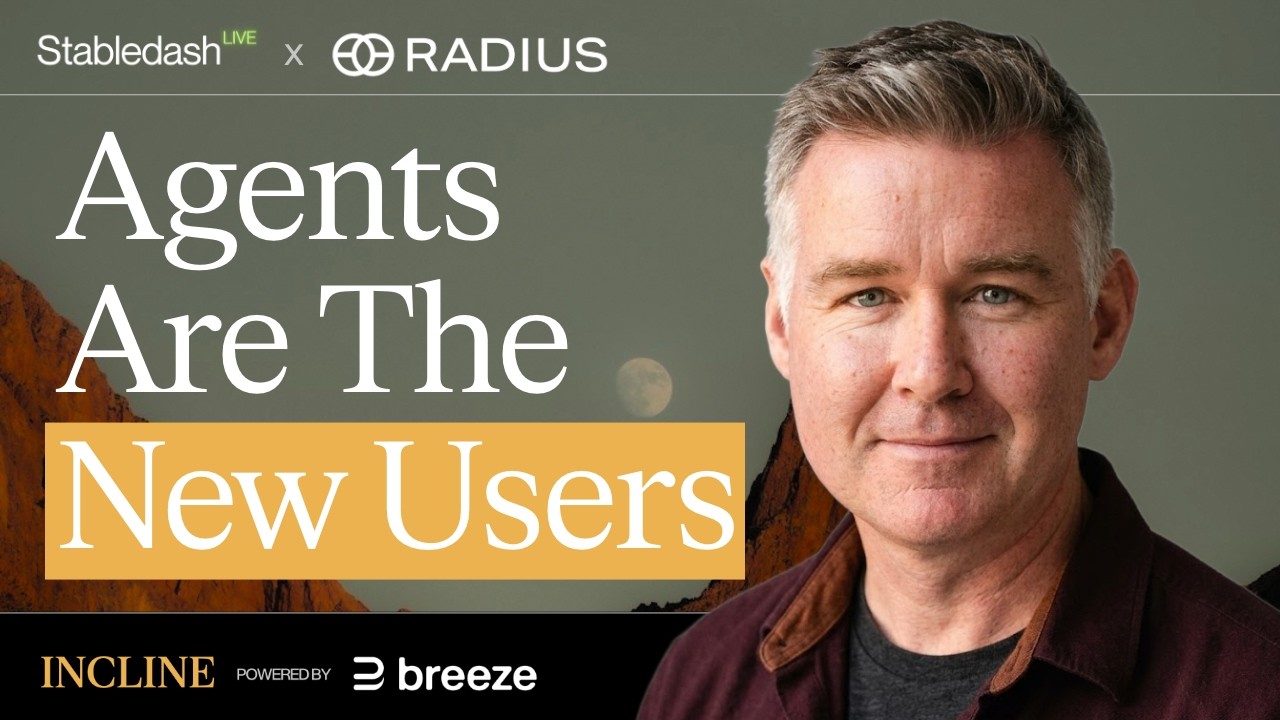
Incline · · 27 min
Celo's Rene Reinsberg on Proof of Human: Why AI Needs Crypto's Guardrails
With 
Key takeaways
Self raised a $9 million seed round in November 2025 and acquired agentic-workflow company Loam in April 2026, making Uber's former Head of AI its COO.
A partnership between Google, USAT and Self lets people verify they are a unique human, connect a wallet and claim free stablecoins.
Reinsberg says Celo Blockchain carries 28% of all USDT transfers across blockchains by transaction count.
Watch the episode

Summary
Rene Reinsberg argues that identity is where agentic workflows stall, and that cryptography could give AI the guardrails it lacks.
Self, the zero-knowledge identity protocol led by Celo co-founder Rene Reinsberg, raised a $9 million seed round in November 2025. In April 2026 it acquired the AI agentic-workflow company Loam, which made Uber's former Head of AI its COO.
Identity as the friction point
Reinsberg says that when traditional companies try to make a workflow agentic, the point of friction is identity: verifying whether someone is human, or who sits behind an agent. Self launched a product called Agent ID for that, and has added preconfigured workspaces for age verification, proof of human and sovereign personhood in its enterprise dashboard.
He describes zero-knowledge proofs as a way to share less with AI. Proving to a chatbot that you are over 18 with a proof based on an ID, he says, avoids uploading a picture of the ID so that all of its content sits in the model's context.
“If you don't want your chatbots to know everything about you. Right? But you want a proof to your chatbot that you're over 18. Right? Sharing a zero knowledge proof that you're over 18 that's based on an ID is really powerful instead of uploading a picture of your ID where suddenly all that content on the ID sits in the context”
Rene ReinsbergFree stablecoins for verified humans
USAT went live on Celo, and a partnership with Google and Self lets someone verify they are a unique human, connect a wallet and claim once. Reinsberg expects that soon there will be major programs where people get a daily allocation of compute.
Celo's stablecoin footprint
Reinsberg says 28% of USDT transfers across all blockchains happen on Celo Blockchain, measured by transfers rather than dollar volume, and that it holds 90% market share by number of holders of Tether Gold. Celo also onboarded seven or eight new non-dollar stablecoins covering Latin American currencies, plus the Nigerian cNGN.
He says close to 80 OTC and cross-border payment companies use it for naira-to-dollar hedging, and he expects on-chain FX yield curves and derivatives to develop within 6-12 months.
Opera and corporate interest
Opera has worked with Celo since around 2021, and its MiniPay wallet is part of that relationship. Reinsberg says it is still early given Opera's 500 million plus active users, and he expects surprises as big corporations return to the technology.
Reinsberg presents security and privacy through cryptography as crypto's other killer use case after stablecoins, a way to keep agents from abusing the data they collect. In his words, crypto brings the guardrails to control the system.


Self, Opera, Google, and Celo come up most.
- People
- Rene Reinsberg
- Charles
- Companies
- Self
- Opera
- Celo
- Tether
- Celo Foundation
- Morgan Stanley
- Uniswap
- Uniswap Labs
- Loam
- Uber
- Anthropic
- Dfns
- OpenAI